Updated: July 2026
Indonesian Private Island vs. Overwater Bungalow: A Luxury Comparison
- Privacy: An island guarantees exceptional solitude versus the shared spaces of a resort.
- Control: Islands allow for fully customized daily schedules, while bungalows adhere to resort-driven activities.
- Scale: A private island is your own exclusive domain, far exceeding the footprint of a single villa.
The turquoise water of the Flores Sea is so clear it feels less like an ocean and more like liquid air. From this vantage point, suspended between a sapphire sky and a living reef, a fundamental question of modern luxury travel presents itself. Do you prefer this view from the glass floor panel of a meticulously designed overwater bungalow, a marvel of engineering and hospitality? Or do you prefer it from the powder-soft sand of a beach that is, for the duration of your stay, entirely and exclusively yours? This is the essential debate for the discerning traveler in the world’s largest archipelago: the iconic overwater villa versus the ultimate statement of escape, a private island in Indonesia. Having spent two decades covering the evolution of ultra-luxury travel, I’ve seen both concepts refined to an art form here, yet they offer fundamentally different philosophies of paradise.
Defining the Apex of Tropical Luxury: Exclusivity vs. Accessibility
The dialogue between these two accommodation styles is a conversation about space and soul. The overwater bungalow, a concept born in French Polynesia in the 1960s, was perfected in the calm, protected lagoons of Indonesia. It is an architectural triumph, a self-contained pod of comfort cantilevered over a vibrant marine world. You are a guest of the ocean, with the resort ecosystem—its restaurants, spas, and social hubs—just a short stroll down a wooden pontoon. A top-tier villa might span 250 square meters, complete with a private infinity pool and direct ladder access to the sea. It is privacy, but with an asterisk; a luxurious suite whose primary amenity is the ocean itself.
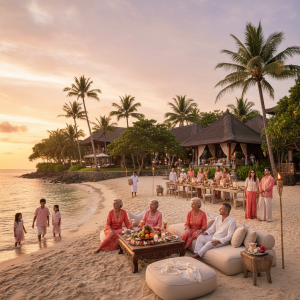
A private island, however, operates on an entirely different philosophical plane. It is not a room with a view; it is the view itself. With an inventory of over 17,500 islands, as documented by the Indonesian government, the nation offers an exceptional canvas for this ultimate expression of exclusivity. Here, the unit of measurement shifts from square meters to hectares. An island like Isle East Indies in the Thousand Islands, for example, is a multi-acre estate where the only other souls are your personal staff, whose mission is to remain invisible until desired. The experience is not about occupying a space within a destination, but about the destination reorienting itself entirely around you. As one prominent hotelier, Adrian Zecha, famously established with his Aman resorts, true luxury is the generosity of space. A private island is the most generous offering of all.
The Geography of Seclusion: Locating Your Perfect Escape
Indonesia’s sheer scale means the location of your chosen sanctuary dramatically shapes the experience. Overwater bungalows tend to cluster in areas of established, high-end tourism infrastructure and exceptional marine biology. The undisputed epicenter is Raja Ampat in West Papua, a region sitting at the heart of the Coral Triangle, which holds over 75% of the world’s known coral species. Resorts like Misool Eco Resort have set the global standard, building their villas over a protected marine reserve that was, just 15 years ago, a shark-finning camp. Similarly, the Anambas Archipelago, a 90-minute seaplane journey from Batam, hosts Bawah Reserve, where 36 standalone suites are scattered across six islands and three lagoons. These are destinations you share, albeit with a very select and like-minded few. The journey is part of the appeal, a multi-leg trip that telegraphs your arrival into a different world.
The portfolio of available private islands offers a different, more dispersed map of seclusion. The Riau Archipelago, south of Singapore, provides accessible yet utterly private retreats. Further east, the islands scattered across the Flores Sea offer a wilder, more profound sense of isolation, often serving as a base for chartering a phinisi schooner to explore nearby wonders like Komodo National Park. The experience of securing a genuine private island indonesia often involves a final leg of travel that is itself exclusive—a private sea plane landing in a calm bay, or a chartered yacht transfer from a regional airport like Labuan Bajo. The logistics are more complex, but they are a filter, ensuring that once you arrive, the world you’ve entered is yours and yours alone.
A Question of Privacy: Shared Horizons vs. Your Own Domain
At its core, the choice is about the texture of your privacy. An overwater bungalow offers what I call “curated privacy.” From your deck, the view is cinematic and unobstructed. You can slip into the water for a swim, and your immediate personal space is respected. Yet, you are aware of the resort’s rhythm. You might see the couple from the neighboring villa paddle-boarding past, hear the distant hum of a boat from the dive center, or see the lights of the main restaurant after dusk. The privacy is absolute within the confines of your villa, but the horizon is shared. For many, this is ideal—a perfect balance of personal space and the reassuring presence of top-tier amenities and social opportunities just a few steps away.
A private island delivers a more profound, almost primal form of privacy. The horizon is not shared; it belongs to your line of sight. The only schedule is dictated by the sun and your own whims. The staff-to-guest ratio can be an astonishing 5:1, a dedicated team whose presence is felt only through seamless service. I once spoke with a guest who had just returned from a week on a private island near Sumba. He said, “The first two days, the silence was deafening. By day three, I could hear the island’s own frequency. By day seven, the thought of returning to a hotel lobby felt like a violation.” This is the essence of the island experience: it’s not just about getting away from it all, but about recalibrating your senses to a state of complete personal sovereignty. It’s the difference between having a private box at the opera and commissioning the entire performance for yourself.
The Experience Itself: Curated Activities vs. Bespoke Itineraries
The operational philosophy of these two luxury models directly impacts the nature of your stay. In a resort setting, even the most exclusive one, the experience is brilliantly curated from a menu of options. You might peruse the daily schedule: 8:00 AM sunrise yoga on the main pavilion, 10:00 AM guided snorkeling tour to the manta ray cleaning station, 3:00 PM spa treatment, 7:30 PM reservation at the Japanese restaurant. These are exceptional, top-tier activities delivered with precision and expertise. The structure is part of the relaxation; the mental load of planning is removed, allowing you to simply choose and enjoy. The resort has identified the best experiences and optimized their delivery for its guests.
The private island model replaces the menu with a blank canvas. The day begins not with a schedule, but with a question from your private concierge: “What does your perfect day look like?” If the answer is “diving a submerged volcano at dawn,” a boat is prepared. If it’s “a gourmet picnic on the deserted northern beach,” the chef begins packing a basket. If it’s “learning to cook a traditional Beef Rendang,” a masterclass is arranged in your villa’s kitchen. This level of personalization is the true luxury. The entire island’s assets—the boats, the marine biologist, the culinary team, the wellness experts—are your private resources. This is where a premier service like Private Island Indonesia excels, acting not just as a booking agent but as a couturier of experiences, tailoring every moment to a guest’s specific desires.
The Financial Equation: Nightly Rates and the Intangible Value
A frank discussion of cost is essential, as the numbers frame the value proposition. A leading overwater bungalow in Indonesia can command a nightly rate from $1,500 to over $5,000 during peak season. This rate typically covers the accommodation and, in some cases, breakfast. All other expenses—dining, activities like diving (which can be $200 per person per dive), spa treatments, and private boat charters—are billed a la carte. For a couple, a week-long stay with a full complement of activities can easily approach $30,000 to $50,000. It is a significant investment in a proven, high-quality product within a shared luxury environment.
The headline rate for an exclusive-use private island is substantially higher, often starting at $25,000 per night and ascending to over $150,000. This figure, however, is frequently misleading. It is typically an all-inclusive rate that covers not just one couple, but the entire capacity of the island, which might be 10, 16, or even 24 guests. It includes all meals, all beverages, all activities, all boat usage, and the dedicated service of the entire staff. When you calculate the per-person or per-couple cost, it can become surprisingly comparable to booking multiple top-tier bungalows at a resort. The true value, however, is intangible. It’s the value of absolute freedom, of not seeing a bill for that extra bottle of champagne, and of an experience that is, by its very nature, unrepeatable. It is the ultimate acquisition for the traveler who has everything: a moment in time where an entire corner of the world is theirs.
Quick FAQ: Your Indonesian Luxury Questions Answered
Is an overwater bungalow safe in a storm?
Absolutely. Modern overwater villas are feats of engineering, built to withstand significant weather events. They are constructed on deep-set, reinforced pylons and located in naturally protected lagoons. Furthermore, five-star resorts have sophisticated weather monitoring and emergency protocols that have been refined over decades. Guest safety is their paramount concern.
What is the best time of year to visit Indonesia for this type of travel?
The general rule of thumb is to target the dry season, which runs from April to October for most of the country, including Bali and the Flores Sea. However, as noted by Indonesia’s official tourism board, the archipelago has complex microclimates. Regions like Raja Ampat have a less defined rainy season, with prime conditions often extending from October through April, making it an excellent winter-sun destination.
Can I get a private island experience for just two people?
Yes, this is a growing and very popular segment of the market. While many islands are designed for larger groups, a significant number of exclusive Indonesian islands specialize in romantic buyouts for couples or small “residence-style” islands designed for a single family. These offer the same level of privacy and bespoke service on a more intimate scale.
How does sustainability factor into these luxury experiences?
It is central. The leading luxury operators in Indonesia understand that their primary asset is the pristine natural environment. Many are deeply involved in conservation, funding everything from coral reef restoration and manta ray research to community development programs on neighboring islands. Bawah Reserve, for example, is a designated marine conservation area, and Misool Eco Resort’s foundation manages a 300,000-acre marine protected area. Responsible tourism is not just a buzzword; it’s a core business principle.
Ultimately, the choice between an Indonesian overwater bungalow and a private island is not a measure of quality—both represent the zenith of hospitality. It is a choice that reflects your personal philosophy of travel. The bungalow offers a front-row seat to a magnificent performance orchestrated by a top-tier resort. The island, by contrast, hands you the conductor’s baton. For the traveler who seeks not just to observe paradise but to inhabit it, to shape its rhythms and compose its memories, the island is the only answer. To explore the archipelago’s most exclusive and secluded estates, the journey begins at Private Island Indonesia.