Updated: July 2026
Is Renting a Secluded Indonesian Island Getaway Safe for Families?
- Controlled Access: Every individual on the island, from staff to guests, is accounted for, with 24/7 security monitoring the sole access points.
- Medical Infrastructure: Premier islands feature on-site clinics, trained medical staff, and robust, pre-planned emergency evacuation routes to international hospitals.
- Vetted Personnel: All staff, including childcare professionals and activity guides, undergo rigorous background checks to ensure a secure environment for all ages.
The sound of the Twin Otter’s engines recedes, replaced by the gentle lapping of the Flores Sea against a wooden jetty. A warm breeze carries the scent of frangipani and salt. Your children are already captivated, pointing at a school of iridescent fish darting through the crystalline water below. You have arrived. This is your world for the next week—an entire island, a private kingdom of sand and sea. Yet, as you take that first step onto the shore, the question that shadows every discerning parent on a grand adventure surfaces: in a place so remote, so seemingly cut off from the world, is it truly safe?
The Architecture of Security in Seclusion
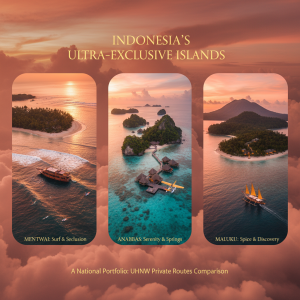
The primary paradox for families considering a private island rental is that its greatest allure—seclusion—can also be its perceived greatest risk. But in the world of ultra-luxe travel, “secluded” does not mean “unsupported” or “vulnerable.” On the contrary, it signifies a completely controlled environment. I once spoke with a security consultant, a former British special forces officer who now advises high-net-worth families, who put it plainly: “A five-star hotel in a major city has thousands of uncontrolled entry and exit points. A private island has one: the jetty.” The entire security posture is built around this principle. Access is by private charter flight or yacht only, with manifests vetted weeks in advance. There are no walk-in guests, no beach vendors, no uninvited visitors. The perimeter is the ocean itself, an immense natural barrier monitored by a dedicated on-site security team, often discreetly positioned and equipped with long-range surveillance and direct communication lines to regional maritime authorities. The staff-to-guest ratio on these islands can be as high as 5-to-1, ensuring constant, yet unobtrusive, oversight. Every staff member, from the butler to the gardener, is part of an integrated security and service apparatus, trained to be observant and responsive.
Medical Preparedness Beyond the Mainland
For any parent, the thought of a medical emergency far from a city hospital can be daunting. This is precisely why the medical infrastructure of a top-tier private island in Indonesia is a primary focus of its operation. We are not talking about a simple first-aid box. Most elite private islands maintain a dedicated clinic staffed by a resident nurse or a physician on 24-hour call. These facilities are equipped with vital diagnostic tools, oxygen tanks, defibrillators, and a comprehensive pharmacy that includes everything from pediatric medications to advanced cardiac life support drugs and anti-venom for marine encounters. I recall touring Bawah Reserve in the Anambas Archipelago, located about 160 nautical miles from Singapore. Their team walked me through their emergency evacuation protocol. It is a drilled, time-tested procedure involving a high-speed boat transfer to a waiting seaplane, capable of reaching Singapore’s top-tier Mount Elizabeth Hospital in approximately 80 minutes. This level of preparedness is the standard, not the exception. Before booking, families should always inquire about the specifics: the qualifications of on-site medical staff, the contents of the clinic, and the precise, minute-by-minute timeline for an emergency evacuation.
A Bespoke and Supervised Children’s Paradise
One of the most compelling safety arguments for a private island is the ability to create a bespoke, supervised environment for children. Unlike a sprawling resort where a child can easily wander off, an island offers a finite and observable space. The activities are not just available; they are curated specifically for your family. If your eight-year-old wants to try snorkeling for the first time, it won’t be in a crowded bay with 50 other tourists. It will be a one-on-one session with a PADI-certified instructor in a calm, shallow lagoon that has already been scouted that morning for currents and marine life. Water safety is paramount. Life jackets are mandatory on all watercraft, private beaches often have submerged netting for protection, and dedicated staff act as lookouts during all water-based activities. The nannies and kids’ club coordinators available for hire are not temporary summer staff; they are career childcare professionals, often with backgrounds in early childhood education and first-aid certification. They can lead guided nature walks, identifying the island’s unique flora and fauna, or organize treasure hunts where the “treasure” is a specially prepared picnic on a deserted stretch of sand. This controlled freedom is the ultimate luxury for a family—the ability for children to explore and be adventurous within a secure, expertly managed setting.
Navigating Indonesia’s Rich Natural Environment
Indonesia is a global epicenter of biodiversity, an archipelago of over 17,000 islands straddling the equator. According to the official tourism board, it is home to a staggering variety of wildlife, both on land and in the sea. While this is a huge part of the appeal, it naturally raises questions about safety. A professionally run island addresses this through a three-pronged strategy: mitigation, training, and education. Mitigation involves proactive, eco-sensitive measures to keep unwanted visitors like snakes or certain insects away from guest villas and common areas. Staff are extensively trained by local wildlife experts to identify and safely handle any creature that might wander into guest areas. Most importantly, upon arrival, families receive a thorough but reassuring briefing on the local ecosystem. They learn which shells are safe to pick up, which marine life to admire from a distance, and what to do if they encounter an unfamiliar animal. This education transforms fear into respect and fascination. In regions like the Komodo National Park, a UNESCO World Heritage site, luxury liveaboards and nearby private islands have operated for decades with impeccable safety records precisely because every excursion is led by expert rangers who understand the animals’ behavior intimately.
Food, Water, and Dietary Diligence
An often-overlooked component of travel safety is food and water integrity, a critical concern when traveling with children whose systems can be more sensitive. On a private island, this risk is virtually eliminated. You are not at the mercy of a massive hotel buffet with potential cross-contamination issues. Instead, you have a private chef and culinary team dedicated solely to your party. Weeks before your arrival, the island’s concierge will be in contact to create a detailed culinary plan. This goes far beyond simple preferences. They will chart out every allergy—be it nuts, gluten, or shellfish—and design menus that are both exciting and completely safe. The entire supply chain is managed to the highest standard. Produce is often grown in the island’s own organic garden or sourced from trusted high-end suppliers, not local markets of unknown provenance. Water is typically produced on-site through advanced reverse osmosis and ultraviolet filtration systems, yielding water that is purer than most bottled brands. For families with infants or toddlers, the chef can prepare fresh, salt-free purées daily, a level of personalized care that provides invaluable peace of mind. This meticulous control over every single thing you and your children consume is a powerful, and often unstated, safety feature.
Quick FAQ on Indonesian Island Safety
Is piracy a realistic concern in Indonesia’s luxury tourism areas?
In the well-trafficked and monitored archipelagos where these private islands are located, such as the Riau or Flores Sea, piracy is not a modern concern. These areas are far from high-risk maritime corridors. Islands employ their own 24/7 security patrols and maintain constant communication with the Indonesian Maritime Security Agency (Bakamla), making them exceptionally hard targets. The last significant incidents occurred decades ago and hundreds of nautical miles away.
What is the protocol for a natural event like an earthquake?
Given that Indonesia sits on the Pacific Ring of Fire, all reputable island resorts have robust and regularly drilled emergency action plans. This includes clearly marked elevated assembly points, comprehensive emergency communication systems (including satellite phones), and access to international tsunami warning networks. The General Manager and key staff are certified in crisis management and evacuation procedures.
How are staff vetted for working so closely with families?
The vetting process for staff on a premier Indonesian private island getaway is exhaustive and far more stringent than a typical hotel. It involves multiple rounds of interviews, criminal background checks conducted by national police, and extensive reference verification that can go back over a decade. For senior roles and childcare staff, this process is often managed by specialist international recruitment firms that add another layer of security screening.
Ultimately, the decision to bring your family to a remote corner of the world hinges on trust. The appeal of a secluded Indonesian island is not just its profound beauty, but the invisible framework of safety that underpins the entire experience. It is the knowledge that every contingency has been considered, every staff member vetted, and every emergency procedure rehearsed. This is not safety by chance; it is safety by design. The greatest luxury, after all, is not the thread count of the sheets or the vintage of the wine, but the absolute peace of mind that comes from knowing your family is in the most capable hands. To discover a portfolio of exclusive-use islands where this principle is the very foundation of their offering, we invite you to explore the collection at Private Island Indonesia, where our team has personally verified the exacting standards of each property.